Suspension Upgrade 🛴 Part 2 - Buidling the Missing Battery
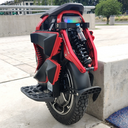

You'll get a charge off of this post!
So today is the day. The BMS (battery management system) has just arrived from China and it's time to assemble this bad boy!

BMS fresh in from China
Before we get started on resuming where we left off, On the left you see the conditions we left the vehicle in last post. On the right we have the same battery towers and suspension guides all cleaned up as promised. The only part of this piece, that shows when assembled, is the Hive stickers. Everything else has something mounted to it.

last post

this post
What we will need for this project is:
- The New Battery Management System (above)
- Lots of these batteries
- Lots of know how for linking 36 of them together correctly
- Padding and silicone to keep them from moving around.

I have an entire box full of cells that need to be measured and paired and then spot welded together, but I am not going to build the entire battery pack from scratch, though I could.

Besides selling my battery for $1,000, as I said last post, I got the old, dead BMS and all the batteries that were ruined by water damage. I am going to save as many of these as I can, and reuse the housings for them.
Each of these clusters has a pair of cells that are in parallel and they should equal 4.2 volts if the batteries are fully charged and being managed by the BMS. I have isolated each pair on the used battery cluster and noted the voltage in marker (above).

Here is how they are wired when in service. All are connected in series. I broke that chain and isolated each pair before measuring voltage. I did that by removing the nickel connections that go side to side. Any that maintained (near) 4.2v can be reused. Any that are zero are junk, they will never take a charge again. Any that have some voltage go in a box for consideration for another future project.
You can see the tabs that point upwards. Those are where the BMS monitors and balances (and equalizes) voltage. on the app that we use to configure these vehicles, you can read the voltage at each of the tabs, on each of the battery pairs, anytime even while riding.
We will get to cutting out the bad battery cells in a bit. I am anxious to open the new BMS!

This is an amazing technical wonder that only costs $70 and all the work I am doing this weekend essentially earns me $930 in savings. That is what know how pays. I am starting the job at 10:00 in the morning and we will see if she runs by sundown.

Here, you can see the silver rectangles on the back of the board. Each one of those will have a cell pair spot welded to it by the end of the day. Remember the nickel tabs you saw on the close up above? Those poke through the BMS board and I will fold them over and attach each battery pair to one of these rectangles.
Now it is time to save the good pairs and get rid of the cells that are not up to par. I can see where the spot welder had welded the nickel plating to the battery and I'm just going to use a Dremel tool to remove some metal from each tiny weld that holds the nickel onto the end of the cell. Here is what that looks like.


Once the old welds are weakened, a good yank on the nickel plate will usually separate it from the cell.


I have a battery operated spot welder and it's charging right now, getting ready for action when all this gets put back together.
The pile over there are the ones that are all bad, or suspected bad. I will have to go through them later to see if any can be used for another purpose, but not for transportation.

The rest of them I have right in front of me are the clusters awaiting a new, good battery pair to be linked up to the BMS. I need to complete the clusters and make sure all of them function as a 126 volt team in the end.
Next, we spot weld the known good batteries in the slots where the bad ones were...

It is hard to see it happen. It just makes a little "tick" sound and sometimes a little smoke. My friend is filming to see if we can capture the moment the weld happens by going frame by frame. It came out good.

I did not feel anything on my hands or see the sparks but the video caught it. Only 40 or 50 more spot welds left to do and this battery is ready to hook up to the BMS.
You need to make the nickel part of the battery and there are no plug-in connections. Soldering wouldn't work because the heat would destroy the battery. Spot welding eats it up just for a fraction of a second and welds the two parts (the nickel and the contact on the battery)
It is 5:00 p.m now...

Okay, you can see all the confirmed good batteries that are going to be charged an equalized via the brain inside the BMS. I have these all put together but I still need to weld all the metal tabs to each pair and get them ready to go under the BMS - more spot welding.
6:30 now

You can see the ones with writing on them. Those were salvaged from the old battery - they are just as good as new, really. These have all been sitting for months without seeing a charger, and the combined voltage is 121 volts. After they are installed and the vehicle is charged to full, they will show 126 volts.
Next I have to insert 12 tabs through the BMS board - there are two that have to go through each slit in the board. I tried putting them through from the top down, then I realized that I will not be able to bend them over to their respective contact.

Best if I flip the whole thing and and put the board down on the tabs.

Each one of the holes with tabs sticking up needs to have one tab from the forward battery and one tab from the rearward battery to connect all the battery pairs in series. I got it to this point and I realized that two of the ones in the middle of the board, did not have both tabs coming out, so I had to take a wooden skewer and fish for the other tab and push it up through. This process took nearly an hour.
Why did I use wood? Anything metal, with these voltages, would be sure fire, and I mean that it the most literal sense.

Once all the voltages match up at the ends then it's time to spot weld each one to the board. If there are any mistakes made at this point and we find one that doesn't have all the contacts in the right place, it would mean grinding each spot weld off and redoing them.
That would be a really big headache. So I'm double and triple checking the work before making it permanent.

Now that we have all the tabs lined up through the board and near their contact points, all that is left to do is, you guessed it, spot weld each one to the new BMS. I bend them 90 degrees until they are sitting on the board, on those metal rectangles we spoke of in the beginning.

I got all the spot welding done and it is quite late. I will try to have this post out in the morning.
The last connections at the end of this big green brick have to be soldered. They cannot be spot welded. There is too much combined voltage at the last connections to be made. Believe me, it would be quicker to spot weld them, but I am already getting shocked if I touch the wrong thing, which is not usually possible with DC circuits.

Next, as we put the fuse in, we get a light show. The BMS starts doing its job - it starts balancing all the batteries. If there is a pair that is higher than the others, the energy is sent to a pair that has less. The lights were spectacular and the camera cannot really capture it. I had to pull out my phone quick before it was all over with.


Here are a couple of shots of my remaining factory battery. Yes, there are two of these per vehicle in order to take us to speeds of 70 per hour and allow us to go down the stairs instead of looking for a ramp.
You can see some of the parts that we installed in their fully packaged form.
My next job is to make this one that I just made look like the factory one. It is not for the looks but there must be waterproofing and padding so that nothing rattles inside. Everything needs to be "tied down" so nothing breaks loose.
I have got foam rubber to pad it so that nothing moves around. You can see the cells installed.

And here is the end cap. This is an isolator that I am putting on it. with silicone to keep it from shifting out of position.

It is late in the evening and the job is essentially done, but see if you can notice what my next problems is...
I will explain it. While I was waiting nearly two months to receive the new BMS, this wheel and its related parts slowly migrated towards the wall and nearly behind the compressor. I did not lose any parts over that wait time. I did however lose some screws - the ones necessary to seal up the installed battery I built.
Both batteries are in the vehicle. One cannot be waterproofed and closed up properly.
I will get new screws tomorrow on my lunch break from work. I guess that means there will be a part three to this project. I have waited this long. I may as well wait another couple of days. I also want to fix the trolly handle used for walking the wheel in spaces that do not allow riding it.
It is midnight now and I stayed up to write this. Tired! I will read this post over and get it out in the morning. Until next time! Thanks for staying with me on this one.
Posted Using INLEO
Congratulations @s22! You have completed the following achievement on the Hive blockchain And have been rewarded with New badge(s)
Your next target is to reach 800 upvotes.
You can view your badges on your board and compare yourself to others in the Ranking
If you no longer want to receive notifications, reply to this comment with the word
STOPCheck out our last posts:
Very impressive! It's been a while, but we've finally been able to appreciate the final result of your work. Thank you for your brilliance and for choosing DIYHub Community to share it.
selected by @jesuslnrs
Knowing how to do these jobs certainly saves us a lot of time; it's important to be resourceful and learn for our economic benefit.
It does save us a lot of time and money. It looks like you do the same with clothing. I still have to buy all of mine. Good work on your new skirt.