Escalating Crisis

The situation in the Middle East is not just failing to deescalate. It is escalating day by day. Attacks continue, threats are increasing, and energy infrastructure is becoming a target. And the markets? They are reacting exactly as one would expect in such an environment: with fear, nervousness, and intense volatility.
THE PICTURE IN THE MARKETS
Let’s start with the markets. Yesterday Wall Street was back in the red, in a session that began with heavy panic selling, while the major indices ultimately closed at better levels than their intraday lows.
What does this mean in practice? It means investors started the day aggressively selling in an effort to reduce risk. Later, we saw an attempt at a rebound, a small comeback, but sentiment remains clearly strained. This is not just a simple technical correction. It is clear risk off behavior.
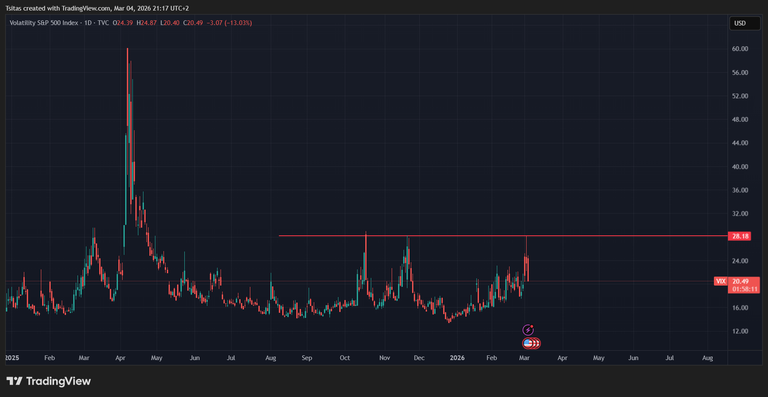
The VIX, the so called fear index of Wall Street, surged to its highest level since November. When the VIX rises sharply, it means investors are buying protection through options. They are expecting larger swings ahead and worry that uncertainty may last longer than initially anticipated.
Almost all sectors of the S&P 500 were in the red, with the exception of financials. Materials and industrials were hit the hardest because when oil prices rise and bond yields increase, production and borrowing costs go up. That translates into pressure on profit margins and lower expectations for future earnings.
Even gold, which is theoretically considered a safe haven during periods of geopolitical tension, pulled back after its initial gains. In short, there were very few places to hide, and the mood was clearly defensive.
Now let’s move to the most sensitive part of the market: chips and technology.
ALL stocks in the sector, from Nvidia to ASML and TSMC in Asia, recorded declines starting from 3 percent and in some cases exceeding 10 percent.
When chip stocks come under pressure, this is not simply a sector specific correction. The entire narrative around artificial intelligence and technological growth is being challenged. Chips are the heart of the AI revolution. If there is an energy shock or disruption in global trade, this sector is among the first to be affected.
The fear here is not only about war. It is about higher energy costs, potential supply chain disruptions, and renewed discussions in the United States about restricting sales of advanced chips to China. If geopolitical tensions are layered on top of already strained trade relations, uncertainty effectively doubles.
OIL AS THE CATALYST
And now we come to the real key to the story: oil.
Brent surged above 82 dollars per barrel, continuing a strong two day rally. WTI approached 75 dollars, while gasoil futures recorded a gain of more than 20 percent, the largest intraday move since 2022. These numbers are not just statistics. They are a warning signal for inflation and for future central bank decisions.
The Strait of Hormuz, through which roughly 20 percent of global oil consumption passes, is effectively in a state of paralysis, as Iran threatens to target tankers and shipping has been drastically reduced. If Hormuz remains closed or partially closed for an extended period, the supply shock could become structural rather than temporary.
As if that were not enough, a drone strike led to the temporary shutdown of Ras Tanura, Saudi Arabia’s largest refinery, with a capacity of around 550,000 barrels per day. At the same time, attacks affected LNG facilities in Qatar and energy infrastructure in neighboring countries. We are talking about critical installations that supply the global market.
This is not just a regional conflict. It is an energy risk with global implications. And when there is an energy shock, there is inflation risk. If oil remains at these levels for weeks or months, inflation could return forcefully.
****WHEN DO MARKETS EXPECT RELIEF?****
The next question is obvious: when do markets expect things to calm down?
According to data from Polymarket, the chances of a ceasefire by mid March are low. By the end of March they do not exceed 45 percent. Probabilities increase as we move into April and May, reaching about 60 percent by the end of April and nearly 75 percent by the end of June.
In simple terms, the market is not pricing in an immediate resolution. It is pricing in prolonged tension, possibly for several weeks. And the longer uncertainty persists, the higher volatility becomes.
https://www.reddit.com/r/Daytrading/comments/1rkx8p2/oil_spike_vix_surge_intraday_volatility_expansion/
This post has been shared on Reddit by @davideownzall through the HivePosh initiative.
Well that opens the door for insider Trading. Imagine all the money made by this. Someone told his friends, " yeah we'll strike it soon".
Idk. Same with peace talks. greater goal is maybe to dry out china and weaken them in a long run.
Yes and polymarket has made inside trading easier than ever !
100% max rape with insider knowledge
Long run like always, train America wins. I dont think we see a huge drop in SP500 anytime soon (maybe if AI makes everything worthless).
Then they will give more weight to AI companies, and they will say the index is up.
yeah i think so too. My logic behind this is will the value taken the same value added?
You know like eat a 100B company, so will those 100B marketcap come on top or is the value of software = 0. Or something like this.
Same for knowledge work if it becomes a commodity. Would not be surprising if selling long term contracts in software/ knowledge work is now really difficult for those big players. Same for big consulting/ accounting.
So i dont know if the value will be 1 to 1, 1 to 0.5 or 1 to 2.
Lets say it ends up deflationary, the impact would be impossible to tell now.
Yes, it could, but humans will always want to interact with other humans, especially in consulting, so I am sure that entry-level and low-level jobs will cease to exist soon.
sure. The real impact is IMO impossible to see now. To early.
It can be like the Internet early. Some win and take it all, others lose the game and dont use it 2 decades later for business.
Maybe thats the most likely outcome.
Who knew "energy infrastructure" could be a trading hot potato 🔥