Crime and Punishment, a journey into the darkest depths of the human soul. [EN/ES]

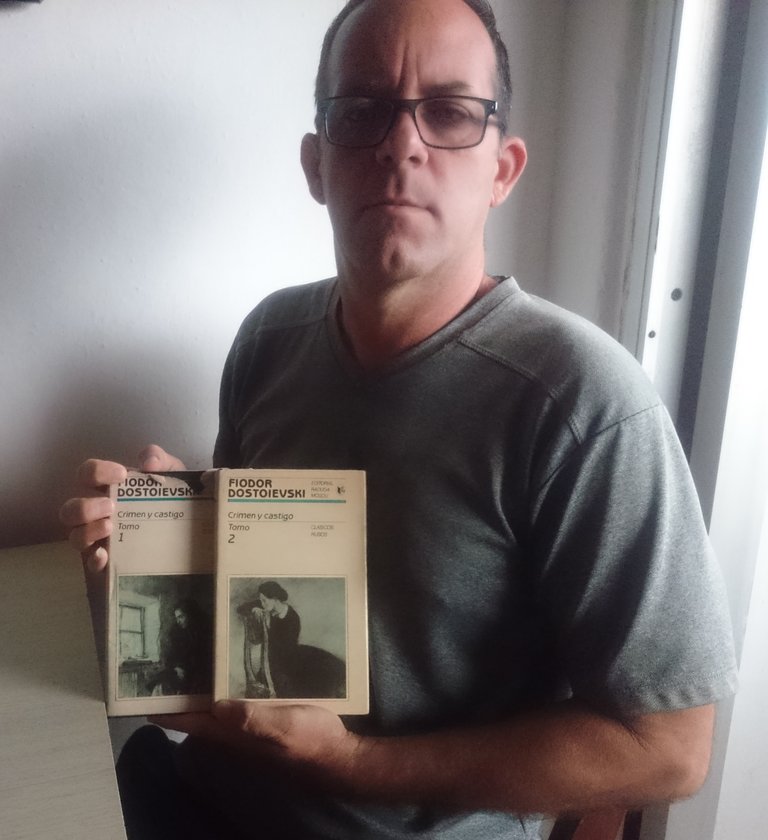
Hello, friends of HiveBook Club. I continue taking advantage of the arrival of these classics into my hands, to review them, reread them, and share them with you along this path of the great classics that have marked the history of literature. Today I want to share with you a work that not only marked Russian literature, but universal literature as well. It is one of the most intense and profound novels ever written, Crime and Punishment, by the Russian author Fyodor Dostoyevsky, originally published in 1866 in Russian.

This book came into my hands at a time when I needed a reading that would confront me, at a moment of deep personal reflection. The work forces you to look inward and question your own ideas about morality, guilt, and redemption. There are stories that are not gentle, that are not comfortable, and this is one of them; it is not written to entertain but to make us look inside ourselves. Crime and Punishment is not just the story of a crime, it is the story of a broken human soul that seeks to justify itself, to escape, and finally to reunite with itself.
It tells us the life of Rodion Raskolnikov, a young student who, driven by extreme ideas about moral superiority and the right to transgress rules, commits a murder believing he does so for a greater good. Very quickly, guilt and the weight of his actions begin to pursue him, and it is there that the novel unfolds all its psychological power.
Dostoyevsky immerses us in an uncomfortable territory, a place where thoughts become a storm, where doubt weighs like a stone, and where conscience becomes an implacable judge. Through the suffering of the protagonist, the author constructs a deep reflection on the human condition, morality, and the need for redemption.
As is now customary, I want to share a fragment that has marked me and that very well summarizes the spirit of the book and of Dostoyevsky himself:
In the Russian language:
"Страдание и боль всегда обязательны для широкого сознания и глубокого сердца." (Фёдор Достоевский, Преступление и наказание, 1866)
In English it would be more or less like this: “Suffering and pain are always inevitable for a broad consciousness and a deep heart.”(Fyodor Dostoyevsky, Crime and Punishment, 1866))
A phrase so simple and yet so devastating constitutes the heart of the novel, the idea that there is no growth without pain, that human transformation requires crossing our own abysses. I had the opportunity to study the Russian language a little and although I confess the translation was done with Google Translate, it gave me satisfaction to see how I could read and understand what I was reading in its original version quite some time ago when I had it in my hands.
Reading Crime and Punishment today is to reconnect with those questions we avoid in everyday life. What is justice really? How far do our ideas take us when they are not accompanied by humanity? Is redemption possible for someone who has crossed the line? Dostoyevsky does not give easy answers, but he does invite us to think, to feel, and to look honestly at our own shadows.
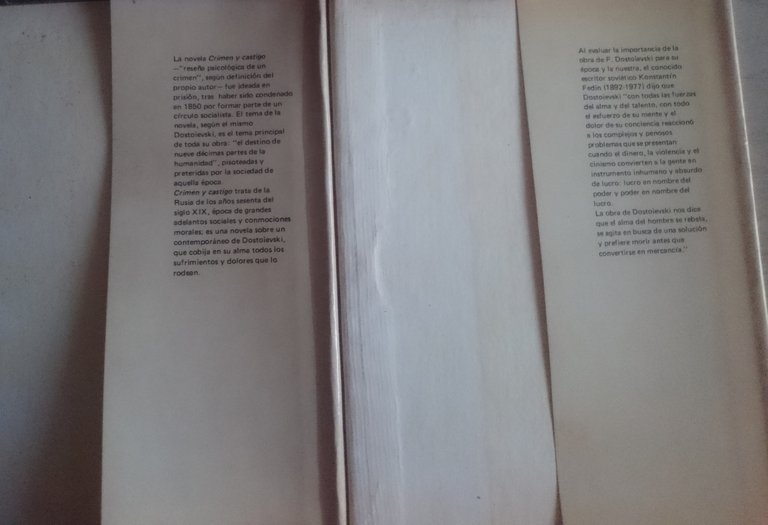

Fyodor Dostoyevsky (1821–1881), one of the great masters of universal literature, lived a life marked by suffering, prison, forced labor, illness, loss, and spiritual crises. In fact, the author himself said that this work was conceived after having been sentenced to prison in 1850 for being part of a socialist circle. All that personal experience is reflected in his works, especially in this novel, where human psychology is dissected with almost surgical precision.
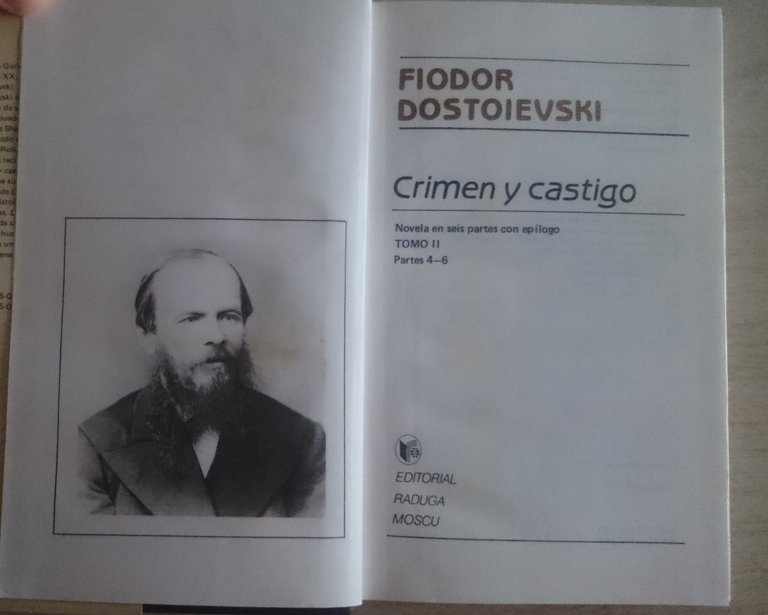
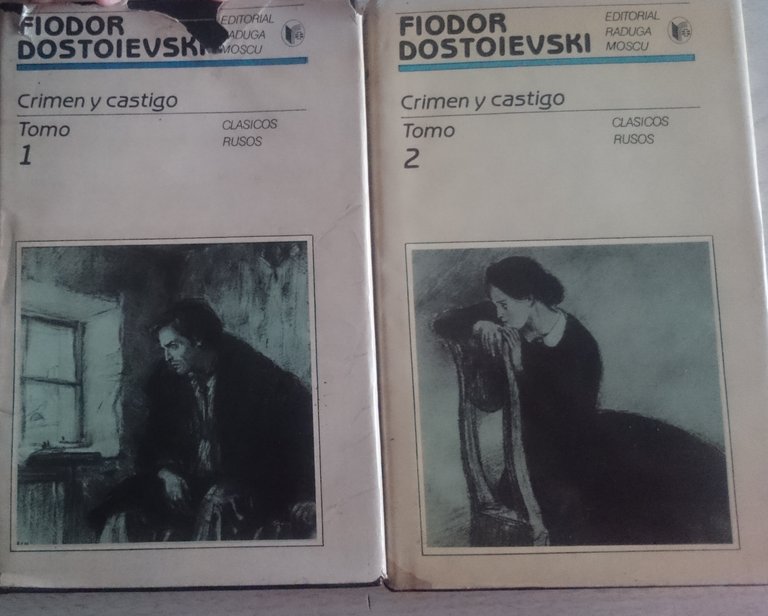
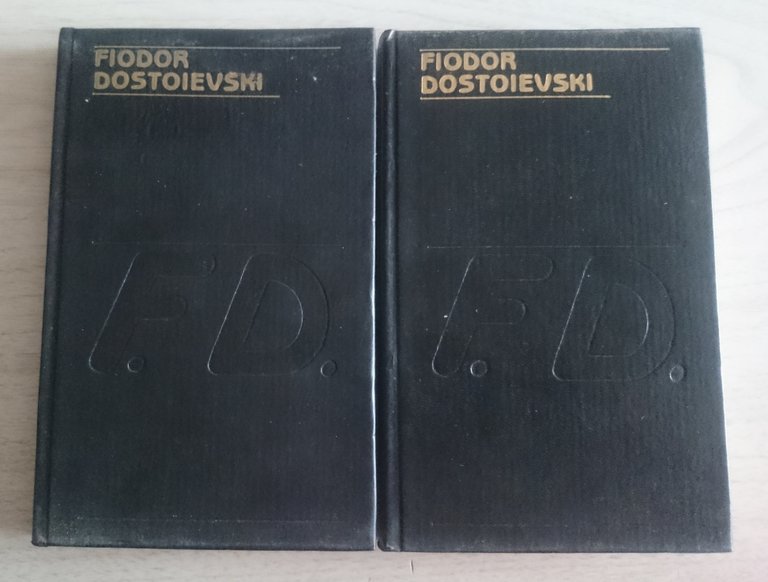
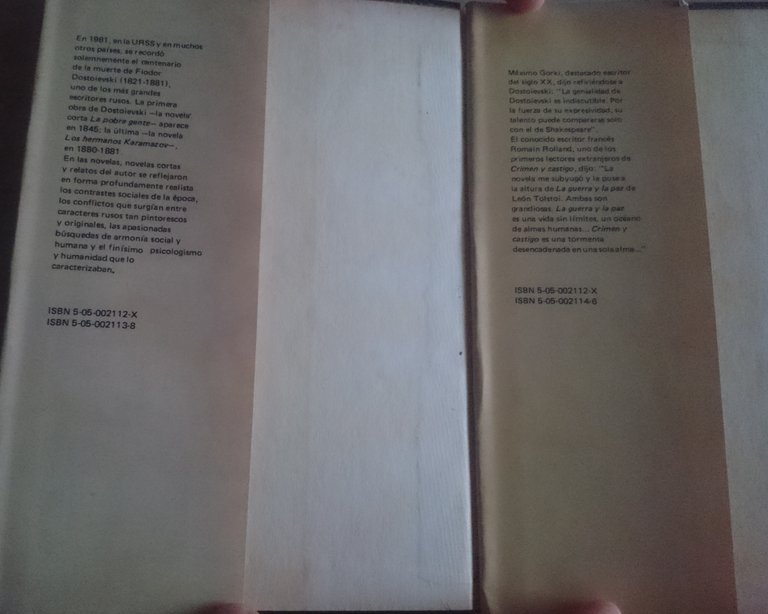
The edition I have in my hands is a Spanish version published by Editorial Raduga, from Moscow in 1989, so it is 36 years old, presented in two volumes that respect the original structure of the novel, divided into six parts, three in each volume. Reading this work in such a carefully produced edition reinforces the feeling of being in front of a classic meant to be read with calm, reflection, and depth. The paper, typography, and physical weight of both volumes perfectly accompany the intensity of the text. Reading it is felt both in the mind and in the hands.
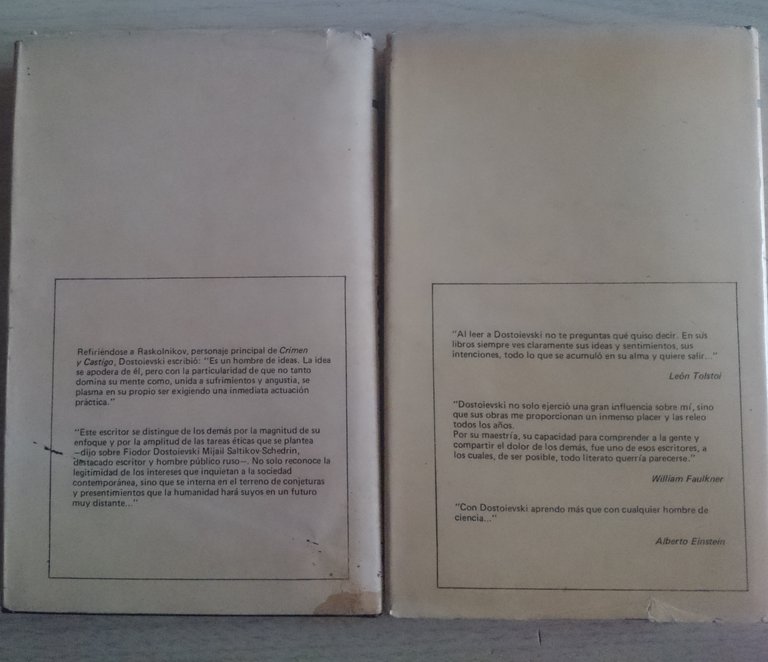
The book also has a paper dust jacket, illustrated and carefully designed, where the title, the author’s name, and quotes from great figures who valued Dostoyevsky’s work appear, among them Albert Einstein and Leo Tolstoy. A detail that reinforces the importance and respect with which this edition was conceived. In one of the volumes, the dust jacket is somewhat deteriorated by the years and use. 159 years after having been originally published in Russian, this work is more alive than ever.
Thank you to the community for this space. I hope this review motivates you to read the novel or to reread it from a new perspective. The photos were taken with a mobile phone and for the English version I used Google Translate. As always, it is a pleasure to share these classics with you.
Spanish Version
Crimen y castigo, un viaje a lo más oscuro del alma humana.
Hola, amigos de HiveBook Club. Sigo aprovechando la llegada de estos clásicos a mis manos, para revisarlos, releerlos y compartir con ustedes por este camino de los grandes clásicos que han marcado la historia de la literatura. Hoy quiero compartir con ustedes una obra que no solo marco la literatura rusa, sino la literatura universal. Es una de las novelas más intensas y profundas jamás escritas, Crimen y castigo, del autor ruso Fiódor Dostoievski, publicada originalmente en 1866 en ruso.
Este libro llegó a mis manos en un momento en que necesitaba una lectura que me confrontara, en un momento de mucha reflexión personal. La obra té obliga a mirar hacia adentro y cuestionar tus propias ideas sobre la moral, la culpa y la redención. Hay historias que no son suaves, que no son cómodas y está es una de esas, no está escrita para entretener sino para mirarnos por dentro. Crimen y castigo no es solo la historia de un crimen, es la historia de un alma humana rota que busca justificarse, escapar y al final reencontrarse consigo misma.
Nos narra la vida de Rodión Raskólnikov, un joven estudiante que, movido por ideas extremas sobre la superioridad moral y el derecho a transgredir las reglas, comete un asesinato creyendo que lo hace por un bien mayor. Muy rápido la culpa y el peso de sus actos comienzan a perseguirlo, y es ahí donde la novela despliega toda su fuerza psicológica.
Dostoievski nos sumerge en un territorio incómodo, un lugar donde los pensamientos se vuelven una tormenta, donde la duda pesa como una piedra, y donde la conciencia se convierte en juez implacable. Mediante el sufrimiento del protagonista, el autor construye una profunda reflexión sobre la condición humana, la moralidad y la necesidad de redención.
Como ya es costumbre, quiero compartir un fragmento que me ha marcado y que resume muy bien el espíritu del libro y del propio Dostoievski:
En idioma Ruso: "Страдание и боль всегда обязательны для широкого сознания и глубокого сердца." (Фёдор Достоевский, Преступление и наказание, 1866)
En español sería más o menos así: “El sufrimiento y el dolor son siempre inevitables para una conciencia amplia y un corazón profundo.”(Fiódor Dostoievski, Crimen y castigo, 1866)
Una frase, tan simple y tan devastadora, constituye el corazón de la novela, la idea de que no hay crecimiento sin dolor, que la transformación humana requiere atravesar nuestros propios abismos. Tuve la oportunidad de estudiar un poco el idioma Ruso y aunque confieso la traducción fue hecha con traductor de Google, me dio satisfacción ver cómo podía leer y entender lo leído en su versión original hace ya bastante tiempo cuando la tuve en mis manos.
Leer Crimen y castigo hoy es reencontrarse con esas preguntas que evitamos en la vida cotidiana. ¿Qué es realmente la justicia? ¿Hasta dónde nos llevan nuestras ideas cuando no están acompañadas de humanidad? ¿Es posible la redención para alguien que ha cruzado la línea? Dostoievski no da respuestas fáciles, pero sí nos invita a pensar, a sentir y a mirar con honestidad nuestras propias sombras.
Fiódor Dostoievski (1821–1881), uno de los grandes maestros de la literatura universal, vivió una vida marcada por el sufrimiento, prisión, trabajos forzados, enfermedades, pérdidas y crisis espirituales. De hecho el mismo autor dijo que está obra fue ideada tras haber sido condenado a prisión en 1850 por formar parte de un círculo socialista. Toda esa experiencia personal se refleja en sus obras, especialmente en esta novela, donde la psicología humana se disecciona con una precisión casi quirúrgica.
La edición que tengo en mis manos es una versión en español publicada por la Editorial Raduga, de Moscú en 1989 por lo que tiene 36 años , presentada en dos tomos que respetan la estructura original de la novela, dividida en seis partes, tres en cada volumen. Leer esta obra en una edición tan cuidada refuerza la sensación de estar ante un clásico pensado para ser leído con calma, reflexión y profundidad. El papel, la tipografía y el peso físico de ambos tomos acompañan perfectamente la intensidad del texto. Al leer se siente tanto en la mente como en las manos.
El libro cuenta además con una sobrecubierta de papel, ilustrada y cuidadosamente diseñada, donde aparecen el título, el nombre del autor y citas de grandes figuras que valoraron la obra de Dostoievski, entre ellas Albert Einstein y León Tolstoi. Un detalle que refuerza la importancia y el respeto con que fue concebida esta edición. En uno de los tomos está sobrecubierta está un poco deteriorada por los años y el uso. A 159 años de haber sido publicada originalmente en ruso está obra sigue más viva que nunca.
Gracias a la comunidad por este espacio. Espero que esta reseña les motive a leer la novela o a releerla desde una nueva perspectiva. Las fotos son hechas con el móvil y para la versión en inglés utilicé el traductor de Google. Como siempre, es un placer compartir estos clásicos con ustedes.
¡Felicitaciones!
Estás participando para optar a la mención especial que se efectuará el domingo 14 de diciembre del 2025 a las 8:00 pm (hora de Venezuela), gracias a la cual el autor del artículo seleccionado recibirá la cantidad de 1 HIVE transferida a su cuenta.
¡También has recibido 1 ENTROKEN! El token del PROYECTO ENTROPÍA impulsado por la plataforma Steem-Engine.
1. Invierte en el PROYECTO ENTROPÍA y recibe ganancias semanalmente. Entra aquí para más información.
2. Contáctanos en Discord: https://discord.gg/hkCjFeb
3. Suscríbete a nuestra COMUNIDAD y apoya al trail de @Entropia y así podrás ganar recompensas de curación de forma automática. Entra aquí para más información sobre nuestro trail.
4. Visita nuestro canal de Youtube.
Atentamente
El equipo de curación del PROYECTO ENTROPÍA
Gracias 👍
Clásico de clásicos bien traído a la palestra. ¡Gracias!
!HUG
Gracias por el apoyo hermano 👍
Un placer hermano.
Abrazos.
Congratulations @vladimirmf! You have completed the following achievement on the Hive blockchain And have been rewarded with New badge(s)
Your next target is to reach 600 replies.
You can view your badges on your board and compare yourself to others in the Ranking
If you no longer want to receive notifications, reply to this comment with the word
STOP