The Journey of San Pedro

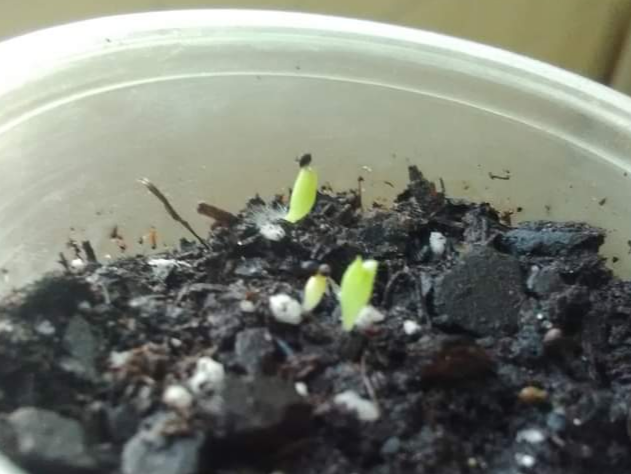
San Pedro cactus, also known as Echinopsis pachanoi or Trichocereus pachanoi, is a columnar cactus that hails from South America. It is a beautiful plant that I have been cultivating ever since the summer of 2021. Back then, they were little more than green specks in the soil, but I was fiercely protective of those little bundles of joy. I would have had 3, as pictured, but a careless sibling somehow knocked over my little container and permanently erased 2 of them. I didn't have a spectacular camera in those days and the plantlets are very tiny, but you can almost make out the tiny fuzz that eventually became fierce thorns.

By autumn of that year, the sole survivor finally looked like a real cactus. Now that it was 50 times bigger, I felt that it was less of a precious fragile baby. Simply watering was a delicate balancing act because I opted out of making a drainage hole in the plastic ramekin. It stayed like that for months until I decided to transplant it. Just look at the salts from our hard water beginning to deposit themselves on the surface of the soil.

These cacti grow quickly. The shriveled section was concerning but I had deduced that it was only the exposed taproot so a little bit of topping up was in order. I know all soil is supposed to contain organic matter but the big chunks of wood included in it are not very conducive to tiny seeds growing because they dry out. A characteristic orange mold is also encrusting itself along the edge of the pot. I noticed we get this a lot in our moist soil.
In the past I tried to research more about these types of cacti. They do not grow in Mexico, but a similar one is found where I like to visit. It has cream flowers which attract many birds. I grows a thick trunk and then many branching arms above that, forming a typical tree shape. This is in contrast to San Pedro's columnar growth habit. I suspect the stranger to belong to the related genus Cereus. It can be difficult to inspect closely though because they grow in the wild mountains or on private property. The ones we own are too young to bloom and the flowers are too high up on wild specimens to make a positive ID. I heard in a video that another method of identification is by counting the number of needles that come out of a single areole. I'm not so sure on this method because, as you can see, many areoles have differing numbers of needles. As the plant grows, more needles sprout from the same spots so there are clusters ranging from about 5 to 7.
I don't remember what the actual number should be, but I guess it doesn't really matter since I got these seeds from a reputable seed company. I mainly wanted the learn how to accurately identify wild specimens, should I ever come across more. The company I got my seeds from is called Strictly Medicinal Seeds. As the name suggests, they sell a wide variety of seeds for plants used in natural remedies (NOTE TO SELF: NEVER BUY WILD LETTUCE AGAIN). They also sell things like compost sieves and equipment to make tinctures, extracts, and the like. I recommend taking a look at their catalogue.

This is the point when I decided it was nearly time to transplant. I learned a valuable lesson when I transplanted my aguacate tree years ago. It made me adopt a new strategy: transplanting to a container only slightly bigger. I made a crucial mistake in picking a pot much much larger than the tree's original pot and it led to watering issues. The final nail in the coffin was root rot, which those trees are very susceptible to but the overarching issue was the root ball being too moist and the large quantity of surrounding brand new soil being bone dry. Eight years of growth down the tubes.
Since then, I've shied away from using store bought soils right out of the bag. When it's brand new it is so hydrophobic. Such soil should only be used as a base and heavily amended with your secret ingredients. Now, every potting occasion demands that a new custom batch of black gold be mixed up. I like it better this way because you can mix only as much as you need and my own organic matter is much better than humungous wood chips. My favorite amendments are worm castings, vermiculite, sand, and coconut coir which is sustainable and, in my humble opinion, superior to peat! Perlite should be smaller grained, in my opinion. Then it would float up to the surface less after watering and look less tacky. Vermiculite just looks better due to its earthy tones. As for the sand? I get that from the beach a short bike ride away. I currently need more but our mild winter was interrupted by some real January weather.
Question
I heard that beach sand should be avoided and that construction sand should be used instead.
Does anyone know why?
I've been trying to figure it out. Maybe they are made out of different materials... All I know is that my sand should be mostly quartz... and it's worked just fine!
As much as I love pointless trips to the hardware store (they might be tired of me) I think I'd rather use the free near limitless supply I have on hand

Oh, how I've patiently waited for the moment to share all these photos in order. The brick design in the background helps us to gauge the growth despite the differences in perspective. The small container serves as a reference to the size of the previous pot. An advantage of having a clear container is that it removes all the guesswork out of when to transplant. A disadvantage is that the dark soil can absorb a large amount of heat when in direct sun which can be harmful to the cactus. Also, the moisture and greenhouse-like conditions can cause algae or moss to grow in between the soil's edge and the pot walls. I don't know how detrimental that can be but best to avoid it entirely. The new pot's size also demanded a drainage hole. The slight bend near the base would cause problems in the future.

Aside from quietly panicking during every watering, I was worried that this transplant was too big of a jump in size. Spoiler alert: it worked out fine. The cactus spent about a year in this pot. You can almost make out some of the different soil chunks from previous pots. I adjusted the angle of the plant to hide the bend but now I notice that it has less character that way. You can see the darker and more swollen areas of the column where growth spurts started in summer and after transplanting. It became very top-heavy. That, along with the taller pot and the bend made ol' St. Pete lose his balance more than I care to admit. While I have been known to occasionally knock small potted plants to the ground, I never did that to this one (well... maybe once). I would say that he likes to knock himself down on purpose. Maybe it was some desperate cry for attention? No amount staking or protection would help. While I always imagined him dancing and scooting himself off the edge, the real problem was that I needed to rotate the plant much more frequently. It was easy to forget about it. They only need water once the soil completely dries out. Watering succulents in the winter seems like walking on thin ice. Pun intended.

Now, we are finally caught up. The cactus almost reaches the doorknob! It has some scarring from a few falls. The growing tip was damaged during one and so I cut it off the eyesore. That may have been a mistake, Now it looks even weirder. The cutting was so small but I put it in some soil anyway. Many months later, it is still green so I guess I have 2 cacti now!

Currently, the cutting is enjoying nervous neighbors and a surprise delphinium, I think. Lately, I have been seriously considering chopping the whole cactus in half and propagating the cutting. These rootlets are encouraging me.

Do you see it? There are more that have sprouted starting from the halfway point of the plant and above. I wonder if the leaning triggered these. That's why it's placed up against the wall. The other leading theory is that since this is the back of the plant, the lack of light along this surface caused rooting hormones to surge. It could also be because I nicked the tip off. This is a useful adaptation in case the break in the wild and land on the ground sideways. Only more areoles along the length would produce branches, not just at the top like mine. Considering that these cacti do not really have a crazy branching habit like others, and that they can grow up to 6m in the wild, maybe cutting it in half is the best way to go? It would certainly solve the stability issues. The new pot itself is stable but the plant's own weight would uproot itself. This has already almost happened.
So I ask all succulent cultivators, what do you think I should do? I could just cut it and plant it, or maybe even make many more cuttings out of it. There is a third option, but it involves murder! Only joking. Well, maybe not for the plant. I could consume part of it. That route requires much more research since I only have a general idea of how to process the flesh as they do in the Andes mountains. It is something very interesting to look into...
Thank you for reading! You input and support are highly appreciated!
Yo Proto
Long time!
Well i ended up getting myself on the hive-watchers black list.
You NEED to come over to blurt man! Using both Hive and Blurt can double your earnings like i have been enjoying in the last year
https://brave-smoke.com/blurt/
Hi! :)
So nice that you have documented your cactus journey...and sorry for the loss of 2 in the beginning..
I have some old photos of my babies....posted them somewhere I guess :) it was back in 2006 before the era of smart phones so I only had digital camera :)
Your buddy started to fatten up :) congrats!
Yes it is a good idea to try some part of it... just to make the stronger bond with the plant :)
You always leave the bottom part with the roots of course and top part can become a new cactus too as you did! :) For example you can split the difference in growth...in parts too :)
The sprouting is because it was trying to make roots, because leaning and because of stress (changing environment) etc...
I feel honored to connect with a brother sacred cacti enthusiast! ;)
Ah, a kindred spirit! You know of what I speak. As you can tell, I have put a lot of effort and care (and worry) into growing this. I don't want to make a critical mistake and more plant clones will be a like a safeguard in case something happens. They will also be more sources of material to use!
I like this. Maybe I will. Thank you for the encouragement and advice!
Yes a teacher plant :) there're a lot of challenges, but it helps us to manage them...even in our own lifes :))
Happy to connect here on Hive! ;)
Congratulations @proto26! You received a personal badge!
You can view your badges on your board and compare yourself to others in the Ranking