Beyond the Dollar: Non-USD Stablecoin Market Hits $1 Billion Milestone, Led by Euro-Backed Assets

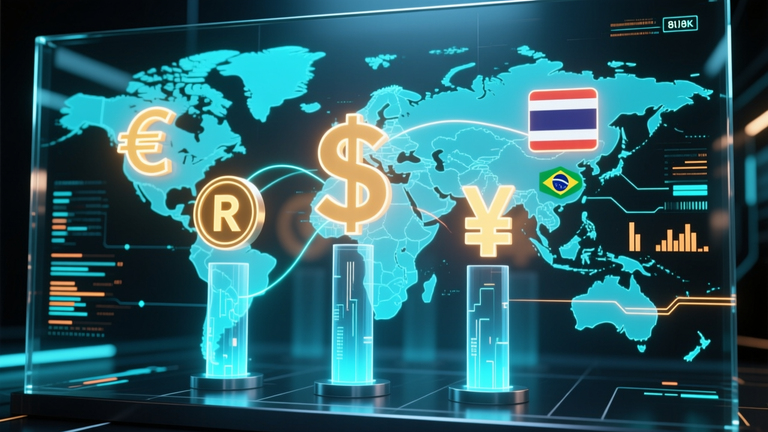
The global digital asset landscape is undergoing a notable shift as users look for stability beyond the dominance of the U.S. Dollar. According to recent on-chain data from Dune Analytics, the market capitalization of non-USD stablecoins—digital assets pegged to local currencies other than the dollar—has officially surpassed the $1 billion threshold. This milestone highlights a maturing ecosystem where regional financial needs are increasingly being met through blockchain technology.
Currently, there are approximately 32 distinct non-USD stablecoins circulating in the market, representing 11 different national fiat currencies. The distribution of these assets provides a clear picture of which regions are leading the charge in local currency tokenization. Europe stands at the forefront, accounting for a substantial 46.9% of the total non-USD stablecoin market share. This dominance is largely driven by the Euro, which remains the most popular non-dollar peg, making up 43.8% of the entire category.
Latin America has also emerged as a critical player, holding a 25% market share. In this region, stablecoins are often used as a hedge against local inflation or as a more efficient means for cross-border remittances. Specifically, the Brazilian Real (BRL) and the Mexican Peso (MXN) have seen significant traction, accounting for 12.5% and 9.4% of the market respectively. Southeast Asia is not far behind, contributing 21.9% to the global total, driven by the increasing integration of digital payments in everyday commerce across nations like Thailand, Indonesia, and Singapore.
The rise of these assets signifies a "de-dollarization" trend within the decentralized finance (DeFi) space. While the U.S. Dollar (through USDT, USDC, and DAI) still commands the vast majority of the overall stablecoin market cap, the growth of local currency pegs suggests that users are seeking ways to interact with blockchain protocols without being exposed to the foreign exchange risks of the dollar. For businesses and individuals in Europe or Brazil, having a stablecoin that mirrors their local purchasing power simplifies accounting, reduces conversion costs, and fosters a more inclusive financial environment. As regulatory frameworks like MiCA in Europe become more established, we can expect the diversity and liquidity of these non-USD assets to expand even further, potentially challenging the status quo of the global digital economy.
Posted Using INLEO