Hello there, I am enjoying a Christmas brunch.

Sweet nectar and a bit of pollen hit the right spot in my tummy.

A Black Potter Wasp (Delta emarginatum) landed on our Christ-Thorn plant. Amazing coincidence in the afternoon on Christmas day.
I have in here the wasp and something new that I will show you at the end of the post. Not only have we an abundance of wildlife here, but the place is also saturated with insects. We found that if we investigate all the insects that we see that some of them live incredible lives. Take, for instance, the dragonfly, did you know that they spend most of their lives underwater as nymphs. Some species of dragonflies spend seven years underwater.
Now, the Potter Wasp is also an interesting insect. Females build a series of one-celled mud nests attached to plants, rock faces, and buildings. They collect water from pools, and then they mix the water with sand to dab it over the completed nest. All species in this sub-family are solitary, with a range of nest types in different areas. Females suspend an egg from the roof of each nest cell and then stack the bottom of the nest with paralysed caterpillars as food for their youngsters when they emerge from the eggs.
A series of photos below of this potter wasp.


Now here is something new, and we have never seen it before.
My wife called to show me this insect that was sitting at the side of a flowerpot, and I was flabbergasted as I didn't know what it was.

I could only see its one eye, and its stout little body.

So, we did some investigations, and the closest that we could find in our insect book is that it is a Toad Grasshopper, possibly the female. But I am not fully convinced of this either. There is always the possibility that it might be something else.

Maybe some insect fundi on Hive will know what it is. At first sight we thought it was a Cicada, but no its shape and the lack of wings showed that it wasn't. Then there is also a possibility that it could be some type of dragonfly larvae, but there is no water around in our back garden. The reason that we think that it might be a toad grasshopper, is that it has various colors and textures that match its surroundings. So, maybe it could be a match, and then again, maybe not. I didn't want to take it off from the flowerpot, and we shall wait to see what happens to it, if it is still here tomorrow. Right now, it is still here and like I said patience might show us what it is, if it is in a development stage. I will keep you updated.
All insect information was taken from our "Field Guide to Insects of South Africa" book. ISBN: 978-1-77584-584-3.
I hope you enjoyed the photos and the story.
Photos by Zac Smith. All-Rights-Reserved.
Camera: Canon PowershotSX70HS Bridge camera.
Thank you kindly for supporting this post.
You have been manual curated and upvoted by @ecency
Did you know that @stresskiller is also a witness now ?
It's a true delight to enjoy these photographic gems you've shared with us! Thank you!
I appreciate your delight and enjoyment of my photos, and thank you for the compliment :)
!PIZZA
All events are interesting and come after a long time, so we should definitely enjoy them. And your photography is very good. Everything is clear and you get a lot of knowledge about flowers from your post.
I agree and we certainly do enjoy them, and glad that you like my photos. We have a few books about the local fauna and flora, and it is a great help to identify the flowers.
Blessings.
!PIZZA
!BEER
Thank you for sharing... I really enjoy macro photography, especially of small objects, animals, flowers, and so on.
You've shared some great photos, some of which look macro with blurry surroundings... that's cool... because the photo only focuses on the main subject.
I hope someday I can get a macro lens...
Thank you, and yes, I also enjoy taking macro shots of the smaller things in nature. Regarding the "blurry" surroundings, I focus on the object, and glad that you know that the ideal is to focus on the main object with no distractions.
My camera is a single lens, and it has a macro setting, so I don't have to use many different lenses.
Have a good day.
!PIZZA
$PIZZA slices delivered:
papilloncharity tipped djbravo
papilloncharity tipped roswelborges
papilloncharity tipped ponpase
@papilloncharity(2/15) tipped @thebighigg
Learn more at https://hive.pizza.
That wasp is really pretty with the iridescent wings! They have an interesting life cycle as solitary creatures, then paralyzing caterpillars to feed the new born wasps. That is really interesting. I don't think we have anything quite like that around here.
That second insect is bizarre, I've never seen anything like it. Of course you are on a whole different continent, so no surprise there. Did you have any more luck finding out what it is?
Strange that you don't have them, as they are spread over many countries.
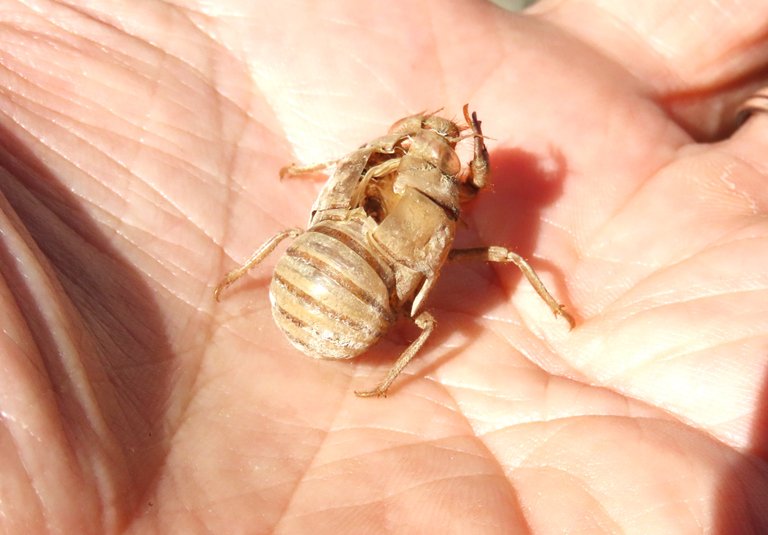
Now the great news is that we managed to find out what it is. The skeleton of a metamorphized Cicada (Platypleura capensis). The hole is from where the newborn escaped from the skeleton. Google it with its specie name and you will see its life cycle. I will in any case do a follow up post on it. I took it off from the pot in order to take some photos, and here is one below.
!BEER
!PIZZA
https://www.reddit.com/r/yellow/comments/1px9ri9/hello_there_i_am_enjoying_a_christmas_brunch/
This post has been shared on Reddit by @wilfredocav through the HivePosh initiative.
Wow, it's so cute! I haven't seen that plant personally.
Thank you and glad that I could show the plant to you :)
That toad thing is strange
My gut feel was right, as it was not a toad after all. In fact, we discovered that it is a Cicada, and I have explained a detailed description with a photo to another reply in the post :)
!BEER
View or trade
BEER.Hey @blanchy, here is a little bit of
BEERfrom @papilloncharity for you. Enjoy it!We love your support by voting @detlev.witness on HIVE .