Part 3/5 – Two Days in Diyarbakır (Amed): A Deeper Journey Through Diyarbakır Museum

I am at the Diyarbakır Museum again in this part of my Diyarbakır trip. But this time I visited another part of the museum. In the first episode, I focused more on the oldest periods. In this episode, what impressed me the most was how widely time was spread. Because there were traces of ancient periods before BC and works from the Islamic period, the Ottoman period and more recent times were exhibited. So you don't actually visit a single museum; it's like you're going through different eras one by one.

While walking in this part of the museum, what I thought the most was this: Diyarbakır is not just an old city, it is like a living memory layer by layer. In one corner, there is information about very old settlements such as Körtik Tepe and Çayönü, in another corner there is Zerzevan Castle, in another place, you come across pots, prostrations, writing sets and daily life items from the Ottoman period. Each showcase says something else. That's why this episode seemed even more interesting to me.


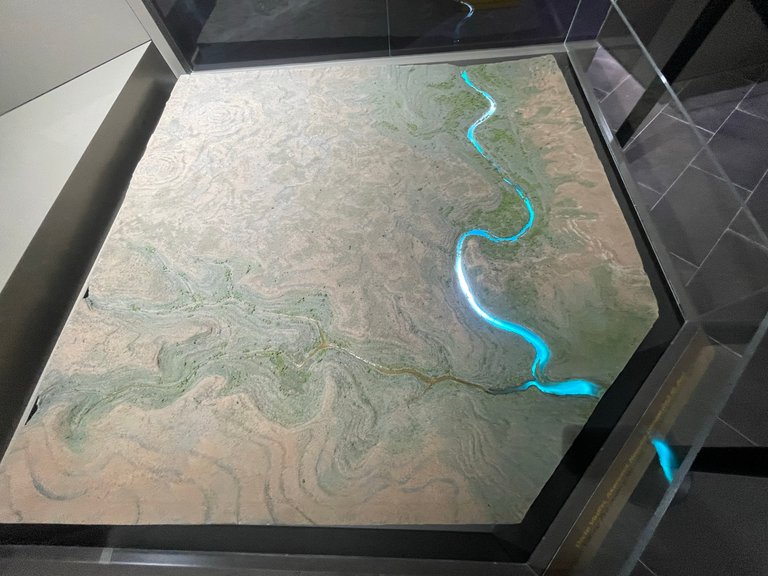
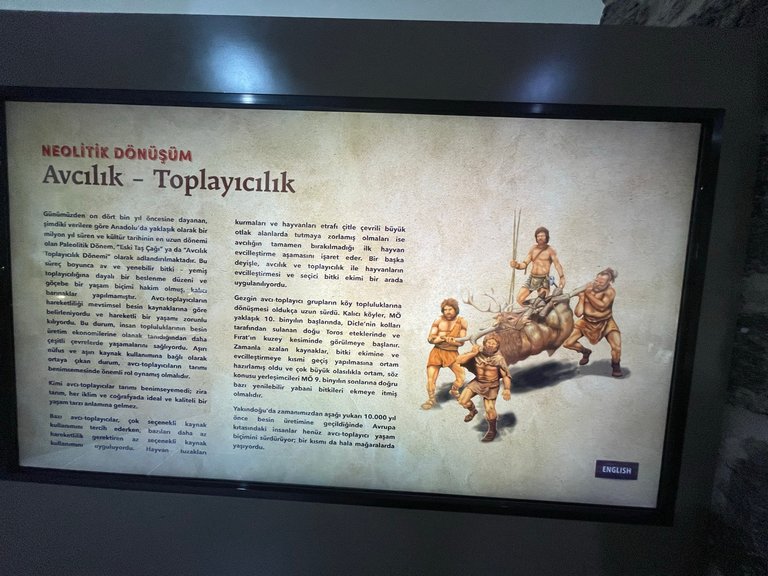
One of the first things that caught my attention was the narratives from very old times. The section about the Tigris Valley, the hunting-gatherer period, Körtik Tepe and the production of stone vessels were really impressive. Sometimes when people say history, they only think of kings, wars, great structures. But here you see the most basic state of life. You feel people's relationship with nature, the process of starting to produce, how they use stones, how daily life is shaped. Especially the animation about the production of stone vessels was very interesting to me. Because you realize how old and effort-consuming even the idea of a cap-kacak that we see very ordinary today is.


The episode about Çayönü was also very striking. The revival of the bury there stops people for a moment. Because history is sometimes not just an object; it is also the life, death, way of life and beliefs of man. When I saw that skeleton, I didn't just look at it as "a very old find". I thought of a real person who lived there. Someone who lived in these lands thousands of years ago, looked at the same sky, stepped on the same land. The museum sometimes affects people with silence, not knowledge. This episode was just like that.


Another interesting part was the part about the transition from production to shopping. The use of obsidian, trade routes and the production process were really important. Because here you also see that human history is not just a matter of survival. People have produced, changed, shared, traded. So the roots of economic life are also very deep. While I was traveling such episodes, I thought to myself: Today's trade, production and market logic are actually like a continuation of a very old story.


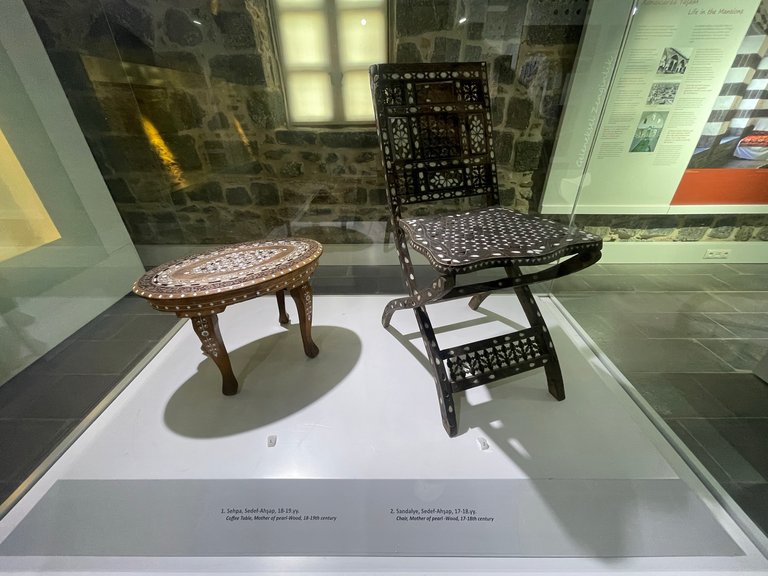
When I moved on to later periods in the museum, a different atmosphere started. In this section, there were Islamic artifacts, everyday items, copper vessels, testicles, hokkas, coffee tables, chairs, prayer and pieces of religious life. These looked very familiar to me. Because we are no longer talking about stone tools, but about a cultural world where we feel closer. Especially copper ibriks, healing stones, writing sets and beautifully processed objects were very remarkable. Both function and aesthetics were together in these works. Man has produced it not only to use it, but also to make it beautiful.


I also liked the section of the mosque and the rosary very much. Because you don't just see an item there; you also see a way of life, a world of faith and a casual habit. When I look at such items, I always think they are part of a house, a room, a family. Once upon a time, someone may have spread that prayer, picked up that rosary, and carried water with that ibri. This thought makes the museum trip more lively.



The section about mosques was also very good. The model of Diyarbakır Grand Mosque especially caught my attention. Seeing the plan of the structure on a small scale allows you to better understand the details. Information boards about Diyarbakır mosques also reflected the religious and architectural richness of the city very well. Diyarbakır is already a very impressive city with its black stone architecture. This section in the museum shows how powerful the city is not only in the streets, but also in thought.


Al Cezeri: A Truly Proud Episode
The most special part of this museum trip for me was definitely the Al Jazeri section. To be honest, this place impressed me a lot. Because Al Jazeri is not just a name; it is a great mind that thought far beyond its time. I once again understood better here how important he is as an engineer, inventor and scientist.

The life of Al Cezeri was told on the boards. It was known that he lived between 1153-1233, was born in Cizre and lived in Diyarbakır. He worked as a chief engineer at Artuklu Palace. Even this information alone is very powerful. Because it is really a great pride that someone who was able to design such advanced machines at that time came out of this geography. Today, we think that things like "robots", "mechanical systems", "automatic devices" are the products of the modern world. However, Al Jazeri thought the basis of these centuries ago.


One of the most remarkable parts was the automatic running water mill model. When I saw the mechanism there, I looked for a long time. Because it's not just a tool, it's like the concrete state of thought. Although it seems to work with animal power, a mechanism has actually been established that allows the water to rise thanks to the hidden system below. So there is not only power, but also reason. There is not only work, but also design. It is truly admirable that Al Jazeri produces solutions using the forces of nature.


I felt one more thing in the El Cezeri episode: Science is not just something done in the laboratory. Sometimes it is born in a city, in a palace, in a courtyard, from daily life. Al Jazeri understood water, wind, movement and energy. Then, using them, he developed systems that would benefit people. That's what's really impressive. A look that is both intelligent and productive and benefit-oriented.


This episode made me think: You shouldn't just look at the past like nostalgia. Because there is really a lot of knowledge in the past. Al Cezeri is one of the best examples of this. When you see your work, you can't help but be proud.


Another remarkable part of the museum was the area related to Zerzevan Castle. There were different pieces here, such as seals, trade, heavyweights, lamps, jewelry and a baptismal bucket. It was very useful to see Zerzevan's chronology. Because it is not enough to see only the works of a place; It is also very important to see what stands out in which period. There is a line here from the Roman period to the Late Roman period. The traces of trade, faith and everyday life were gathered in the same area.


Especially the information about the trade part and the baptism bucket was very interesting. On the one hand, there were traces of economic life, on the other hand, there were artifacts related to religious rituals. This showed me: Human history is not one-way. At the same time, there is both faith, production, there is war, there is art, and daily life continues. This part of the museum made it feel so good.


In general, this second museum section seemed more complicated but richer to me than the first section. Because you don't focus on a single time here. You are making a wide journey from ancient times to the Islamic period, the Ottoman period and more recent times. This makes traveling more exciting.


While visiting the Diyarbakır Museum, I thought once again: This city is very strong not only with its present but also with its past. There is another story in every corner. There is another time in each window. And the best thing is this: These stories don't just stop on stones, pots, jewelry or models; they continue to live in the human mind. So this museum trip was not only a trip for me, but also a journey of thought.


You can check out this post and your own profile on the map. Be part of the Worldmappin Community and join our Discord Channel to get in touch with other travelers, ask questions or just be updated on our latest features.
Sending you Ecency curation votes.😉

!discovery
!PIZZA
This post was shared and voted inside the discord by the curators team of discovery-it
Join our Community and follow our Curation Trail
Discovery-it is also a Witness, vote for us here
Delegate to us for passive income. Check our 80% fee-back Program
$PIZZA slices delivered:
@jlinaresp(9/15) tipped @oneplanet
Learn more at https://hive.pizza.
Congratulations @oneplanet! You have completed the following achievement on the Hive blockchain And have been rewarded with New badge(s)
Your next target is to reach 60000 upvotes.
You can view your badges on your board and compare yourself to others in the Ranking
If you no longer want to receive notifications, reply to this comment with the word
STOPCheck out our last posts:
Personally, I love museums. Each one, in its own category, is very interesting, with so much to learn and even to understand about the history and evolution of a city. Best regards.
Thanks dear for this lovely comment🌸