Part 2/5 – Two Days in Diyarbakır (Amed): Diyarbakır Museum & A Journey into Ancient History

I’m here again hello🌸
In this part of my Diyarbakır trip, I want to tell you about the Diyarbakır Museum. I decided to share this museum trip in two separate sections. Because the museum is so rich, so full that I didn't want to fit them all into a single article. In this first part, I wanted to include the oldest periods of the museum, that is, the part that goes back thousands of years. Frankly, this place really impressed me. In some places, I didn't just look and pass, I stopped and thought for a long time. Because many of the items I saw in the window almost survived from the earliest times in human history.


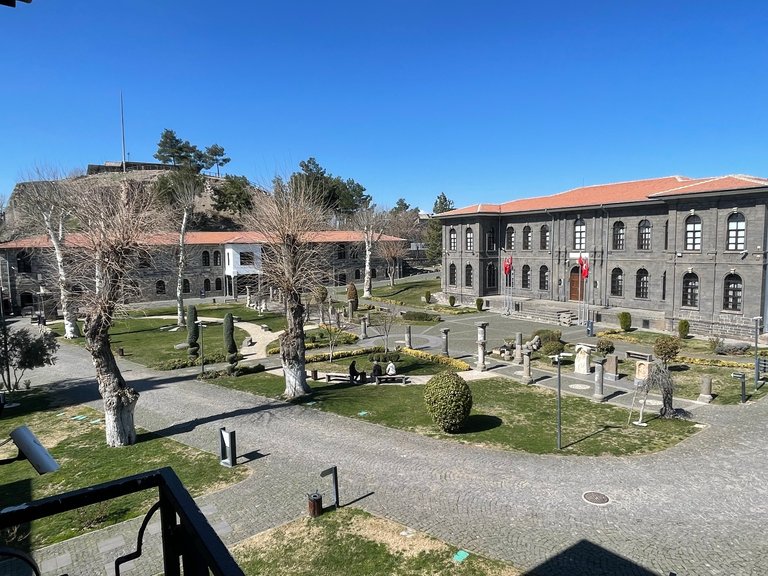
Even the entrance of the museum was very impressive. Structures made of black stones, the courtyard, the old stone walls and that atmosphere take you to another time. That strong historical texture of Diyarbakır makes itself felt very clear here as well. Even before entering, there is a feeling of "I will see a lot here". While walking in the courtyard, I looked at the beauty of the stone buildings, and on the other hand, I thought about the works I would see soon. Diyarbakır is already a city that gives a very strong sense of history in itself. The museum makes it even deeper.


One of the first things that caught my attention when I entered was the Diyarbakır chronology. There, it was shown very clearly how old and how important a historical area Diyarbakır was. Sometimes we say “too old” for a city, but the issue here is really very old. Not a few hundred years, not a few thousand years. We are talking about a past that dates back thousands of years, to very early periods of human history. Seeing this on a board is another thing to see the real items left over from that period in the window. I was really impressed at that moment.


There were very old tools made of stone tools, obsidians and flints in the museum. When you look at these, people inevitably think: What kind of life did people living in such old times lead? How did such fine things come about when the opportunity they had was so limited? Today, we have technology, machines, ready-made materials. But thousands of years ago, people were building their daily lives by carving stones. Cutting tools, small tips, different pieces of stone... All of them were both very simple and very meaningful.


One of the things that impressed me the most was jewelry. We can see the pottery in almost every museum. Of course, they are also very precious and very beautiful. But the necklaces, rings, earrings, small ornaments I saw here really enchanted me. Because even in such an ancient time, you see that people were not satisfied with just living. They also cared about beauty. Elegance, aesthetics, desire to be decorated... Seeing how old these are made me think a lot. So it's nothing new that women like elegance. Thousands of years ago, people wanted to look beautiful, decorate themselves, use different jewelry.


Especially the necklaces were very remarkable. Thin pieces, small beads lined up side by side, carefully prepared ornaments... As you look at them, "How could this have been made?" I thought. It seems really incredible to do such fine workmanship in the conditions of that period. Not only the jewelry, but also the needles impressed me a lot. Some of the needles were so thin that I was surprised. It's really fascinating that the needle idea we use now existed in such old times. Sewing, combining something, processing, producing... Seeing how old all of these are gives a person another sense of respect.


It may seem strange at first to look at a needle and be so impressed, but it really was. Because it is an object that we see very ordinary today, in fact, the product of great intelligence and patience in human history. How did they do such a subtle thing? How did they shape it? How did they use it? I couldn't help but think about these. That was exactly the reason why I sometimes stayed in front of a work for a long time while walking in the museum. Not just from the look of an "old thing", but "what was the person who did this like?" I looked with the feeling.


There were also war-related pieces in the museum. Some works about arrowheads, armor pieces, weapons also remind people that history is not just about beauty. On the one hand, there are elegant jewelry, fine workmanship, everyday life items; on the other hand, there are traces of war... Everything together in history. Man produced, decorated, built life; but also fought. This contrast is very clearly felt in the museum. You see aesthetics and subtlety in one showcase, power and defense in another showcase.


Ceramic pots and pots were also very impressive. Some were very simple, some were more flashy. There were containers used in daily life, forms made for storage, and artifacts of different sizes. When you see pottery, people can sometimes pass quickly because they get used to it, but I watched them with a different eye here. Because even the form of a container gives us information about life. What people ate, what they hid, how they produced, what kind of house layouts there were... It's all somehow hidden in these works.


What I felt the most in this first part of the museum was this: Diyarbakır is a very important center not only of today, but also of ancient times. The works found here clearly show this. I was excited to see how important Diyarbakır stood in terms of prehistoric periods. Sometimes we know some cities only by their current identity. However, some places have become very important areas where people have lived, produced and left traces for thousands of years. Diyarbakır is definitely one of them.


While visiting museums, I usually don't just get information, but I also try to establish a bond. It happened here too. Because every item behind the shop window told me: Man has been the same person since ancient times. He wants to live, he wants to produce, he wants to protect himself, he loves the beautiful, he wants to be decorated, he wants to leave something. Thousands of years have passed, but some feelings have never changed. Perhaps that was what impressed me the most.


This first part of the Diyarbakır Museum was really unforgettable for me. Especially the oldest works, stone tools, fine needles, elegant necklaces and jewelry will remain in my mind for a long time. There is a huge difference between reading history only in the book and seeing it in front of your eyes. This museum made me feel it once again. In the second part, I will also share works from later periods. But this first chapter, that is, the oldest layer of the museum, was very special and very impressive to me in itself. Here I understood once again how deep, how strong and how deep-rooted Diyarbakır is.
You can check out this post and your own profile on the map. Be part of the Worldmappin Community and join our Discord Channel to get in touch with other travelers, ask questions or just be updated on our latest features.
Sending Ecency love your way, thanks for using Ecency.

This post has been manually curated by @bhattg from Indiaunited community. Join us on our Discord Server.
Do you know that you can earn a passive income by delegating to @indiaunited. We share more than 100 % of the curation rewards with the delegators in the form of IUC tokens.
Here are some handy links for delegations: 100HP, 250HP, 500HP, 1000HP.
100% of the rewards from this comment goes to the curator for their manual curation efforts. Please encourage the curator @bhattg by upvoting this comment and support the community by voting the posts made by @indiaunited.