Film Review: Blockade (1938)

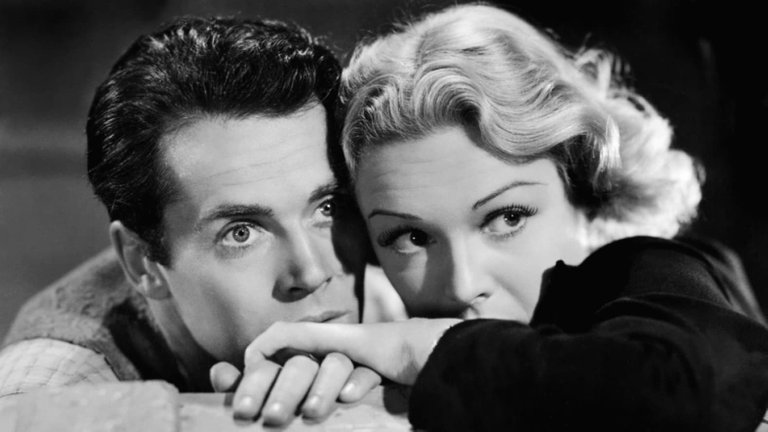
Hollywood is known for its authors traditionally having their politics set firmly on the Left. Many of them have never shied from expressing their leftist beliefs in their works, even in times when doing so was quite risky or counterproductive. Results of such efforts weren’t always good, even from a mere propaganda standpoint, as in the case of Blockade, a 1938 film directed by William Dieterle, known as one of the rare Hollywood films about the Spanish Civil War made while that conflict was still raging.
The plot begins in Spain in spring 1936, at a time when the country is still at peace. The protagonist is Marco (played by Henry Fonda), a farmer from a Spanish region somewhere near the Mediterranean coast who, together with his best friend Luis (played by Leo Carillo), a shepherd, meets a beautiful foreigner named Norma (played by Madeleine Carroll) who has just had a car accident. He drives her to a nearby town and hopelessly falls in love with her. She has other concerns, namely a meeting with her father, White Russian émigré Basil (played by Vladimir Sokoloff), who travels the world, nominally as an art dealer but actually working for mercenary spy Andre Gallinet (played by John Halliday). There is soon plenty of work for them because a few months later war erupts. During the initial battles, Marco, with his rousing speech, inspires fellow peasants to stand and fight and prevent the enemy from overrunning the strategically important city of Castelmare. For this feat he is promoted to lieutenant and given the new task of rounding up and eliminating enemy spies. That would get him back in contact with Norma, who very reluctantly aids Gallinet in his evil plans to prevent a ship from bringing food and other precious supplies to civilians in besieged Castelmare.
Blockade was produced by Walter Wanger, a producer known for championing various liberal and progressive causes (despite, ironically, producing Gabriel Over the White House, one of the rare pro-fascist films ever to be made in Hollywood). The real driving force behind the film was screenwriter John Howard Lawson, a card-carrying member of the Communist Party USA, an organisation which officially supported the left-wing government of the Spanish Republic, aided by the Soviet Union, in its war against right-wing rebels led by General Franco and aided by Nazi Germany and Fascist Italy. Wanger and Lawson, however, had a serious obstacle in expressing their sympathies directly, because the MPAA Production Code and Hays Office, led by Catholic activist Joseph Breen, prevented Hollywood films from getting involved in contemporary international politics. The only way to obtain an MPAA certificate was to pretend that they were neutral in the conflict, and they did so by erasing any references, uniforms, insignia or any detail that would point to the actual warring sides. As a result, Marco could have been fighting for Republicans as well as Nationalists. More perceptive viewers could, on the other hand, easily guess that Marco supported the former, based on his taking the side of ordinary farmers and opposition to the latter, who, like the usually unseen enemy in the film, practised terror bombing of civilian targets, much to the horror of more sensitive segments of the international public.
The latter segments of the film, which depict the suffering of innocent women and children in a bombed-out and besieged city, are clearly intended to evoke sympathy for the cause of the Spanish Republic. Wanger and Lawson, however, failed in their task. The main reason is the overcooked and complicated script that meanders between war film, spy thriller, cheap melodrama and preachy sermon. Dialogues are at times awful, and the script (which had uncredited contributions by famous crime writer James M. Cain and playwright Clifford Odets) is also sloppy with some details, such as Marco and a couple of locations in the film having Italian instead of Spanish names. The character of Luis, who was obviously designed as a sort of comic relief, speaks with a heavy Spanish accent unlike the rest of the cast, who speak with British or American accents, thus wrecking the suspension of disbelief and turning Luis almost cartoonish. Even worse is the introduction of British reporter Edward Grant (played by Reginald Denny), who begins as another comic relief only to suddenly turn into the voice of conscience, prophetically warning that the bombing of Spanish cities is the fate that awaits cities like London.
On the other hand, experienced director William Dieterle does what he can with the material and does a solid job with studio sets and manages to depict war action, which involves air raids and submarine attacks, with a combination of decent special effects and stock footage. Madeleine Carroll, one of the most glamorous actresses of her time, tries very hard with her role, despite being burdened with terrible dialogue and often tempted to start overacting. John Halliday, a British actor specialising in the role of suave aristocrats, is effective as a slick and dangerous villain. But those efforts are compromised by Henry Fonda, then a young and relatively unknown actor, who delivers one of the worst performances of his career. He is simply unconvincing as a Spaniard or a farmer and lacks chemistry with Carroll. The scene in which he delivers a seemingly rousing speech that would make peasants stand and fight looks almost self-parodic. The final scene, during which his character addresses the camera and asks the world to intervene and stop the war, completes the impression of Blockade as a failure.
Despite the producers’ efforts to avoid controversy, theatres showing Blockade were picketed by the Knights of Columbus and other Catholic organisations over the film’s pro-Communist or anti-Catholic bias. Lawson nevertheless received an Oscar nomination for Best Original Story. By the time awards were to be given, the war in Spain had ended with Franco’s victory. Lawson nevertheless learned from his mistakes, and Blockade, like the Spanish Civil War itself, proved to be a valuable lesson for the Second World War, a conflict in which Hollywood, including Lawson, provided propaganda more openly and successfully. His Communist beliefs, however, brought his career to an end in 1947 when he, as a member of the Hollywood Ten, became one of the first victims of the McCarthyist purges of Hollywood. Even the apolitical Dieterle had his career affected by suspicions of Communism promoted in Blockade. This film, regardless of someone’s political stance, definitely wasn’t worth such trouble, and those who watch it today are likely to see it as a mere curiosity rather than a good piece of cinema from Classic Hollywood.
RATING: 4/10 (+)
Blog in Croatian https://draxblog.com
Blog in English https://draxreview.wordpress.com/
Leofinance blog https://leofinance.io/@drax.leo
Unstoppable Domains: https://unstoppabledomains.com/?ref=3fc23fc42c1b417
Hiveonboard: https://hiveonboard.com?ref=drax y
Bitcoin Lightning HIVE donations: https://v4v.app/v1/lnurlp/qrcode/drax
Rising Star game: https://www.risingstargame.com?referrer=drax
1Inch: https://1inch.exchange/#/r/0x83823d8CCB74F828148258BB4457642124b1328e
BTC donations: 1EWxiMiP6iiG9rger3NuUSd6HByaxQWafG
ETH donations: 0xB305F144323b99e6f8b1d66f5D7DE78B498C32A7
