Film Review: Aquaman (2018)

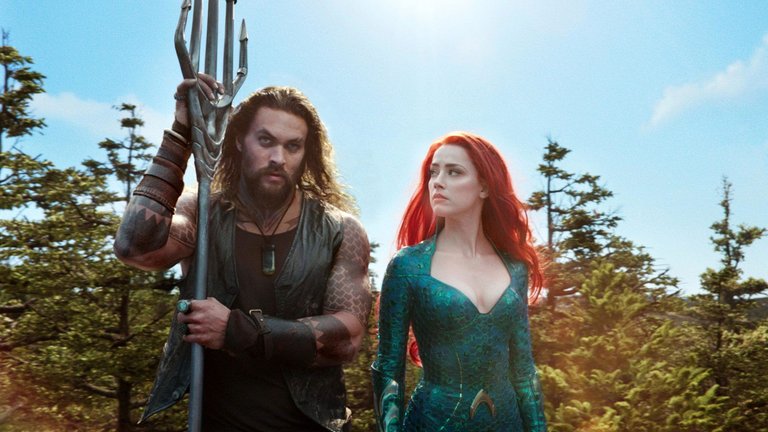
The past few years have not been the best for Warner Bros., at least judging by the performance of that studio's biggest hopes—the films of the DC Extended Universe, the project with which the studio was supposed to show Disney and their Marvel Cinematic Universe who is boss. However, even when the most popular comic book heroes like Batman and Superman were on screen, it did not prevent the DC Extended Universe from ending up in a clash with Marvel just as the German Imperial Navy did against the British Royal Navy in the First World War.
By a twist of fate, the only ones who managed to salvage the honour of Warner and DC Comics from this fiasco were second-string comic book heroes largely unknown to the wider public. And while 2017 success of Wonder Woman could partly be explained by its strong feminist charge which won over the hearts of SJW-leaning critics, when the same thing happened in 2018 with Aquaman, a slightly different explanation needs to be found.
Aquaman, one of the lesser-known DC Universe superheroes, first briefly appeared in the new film series in 2016 as one of the "meta-humans" in the infamous Batman v Superman: Dawn of Justice, before being a team member last year in Justice League. The new film is dedicated solely to him, and can also be understood as a kind of "origin story", although the main plot takes place after the events depicted in the previous films of the series.
Following a prologue describing how Arthur Curry, aka Aquaman, was born in 1985 as the fruit of the love between lighthouse keeper Thomas Curry (Temuera Morrison) and Atlantean princess Atlanna (Nicole Kidman), the action moves to the present. Here, the now adult and, thanks to his superhero powers, famous Aquaman (Jason Momoa) must face temptations coming from Atlantis, the underwater kingdom where his mother disappeared. It is now ruled by Aquaman's half-brother Orm (Patrick Wilson), who has decided to unite all the underwater kingdoms and lead them in a great war against the surface human civilisation, which he holds responsible for polluting the seas. He is sought to be stopped by Mera (Amber Heard), princess of the underwater kingdom of Xebel, who comes to the surface and begs Aquaman for help. He is supposed to become the king of Atlantis by finding the legendary trident of King Atlan, which grants its bearer sovereignty.
The direction of Aquaman was entrusted to James Wan, an Australian director famed for a series of praised and commercially successful horror films, but who also earned acclaim for the action film Fast Five. This new project represented not only a foray into new genre waters, but also perhaps the most ambitious and complex film in that filmmaker's career. All things considered, Wan largely succeeded in his endeavour, and Aquaman can currently be considered the best of all the films in the DC cycle.
The main reason for this is that Wan handled the $160 million entrusted to him by Warner Bros. extremely deftly, but also because he understood that a superhero film today can only be successful if it resembles other superhero films as little as possible. In the case of Aquaman, the main element is water, which not only represents the main setting but also, in the case of the hydrokinetically-gifted Mera, one of the means of dealing with villains. Wan skilfully uses state-of-the-art CGI effects in the film to depict manipulation of water in both worlds, and also convincingly shows how Aquaman can breathe and move underwater without any problems. However, the most impressive seems to be the effort invested in making the underwater worlds as attractive as possible, and likewise their inhabitants distinct from one another. The result is a series of impressive scenes which will, especially if the film is watched in cinemas with 3D glasses, have the same effect that the scenes of Pandora had about a decade earlier in the case of Avatar.
Wan even succeeds where many superhero films often fail—the final showdown; instead of being yet another anticlimactic and drawn-out punch-up in the style of The Avengers, here it takes the form of a truly epic battle, which Wan crafted in the style of Jackson's battles in The Lord of the Rings, and which even makes some sense in the context of the plot, ending precisely at the moment it should.
Wan can make even relatively short scenes that take place on land attractive, be it the Curry lighthouse, the Sahara desert, or a picturesque Sicilian town where one of the action sequences will take place. The impression is further enhanced by a catchy yet unusual soundtrack based on synthesisers, which will remind film music connoisseurs of the best works of Vangelis and Kitaro.
The film's appeal can also be seen in the choice of lead actors, who can hardly be declared top-tier dramatic artists, and whose careers have had considerable ups and downs in recent years. However, Aquaman will help two main actors to shed that baggage—many will forget Momoa in the ill-fated Conan the Barbarian remake after this, just as Amber Heard will win back at least some of the goodwill she lost thanks to fans of Johnny Depp and admirers of Elon Musk. The two of them portray relatively simple characters of traditional hero and princess, and they perform this task very well, also creating good on-screen "chemistry".
The rest of the cast is mostly good, which includes Patrick Wilson in the role of a villain unusually "cool" and intelligent by today's Hollywood standards, as well as Willem Dafoe, who could play a role like Aquaman's mentor Vulko with his eyes closed. Some of the actors, however, are reduced to roles little more than cameos, and in the case of Morrison and Kidman, are burdened by the need to be digitally de-aged at times by not-always-convincing CGI.
The biggest shortcoming of Aquaman, however, is the screenplay, which in terms of quality is even below the low standards to which modern Hollywood blockbusters have accustomed us. This refers to the appalling dialogue which even the most fanatical admirers of this film will probably want to ignore or forget. The dialogue, however, is an even smaller problem than the extremely drawn-out and unattractive beginning. Things generally improve after the first third of the film, but there is still a structural problem caused by the need to insert the comic book super-villain Black Manta, played by Yahya Abdul-Mateen II, into the relatively simple story of Aquaman's conflict with Orm. He is saddled with a melodramatic subplot for which it is immediately clear that it is a nuisance, but which nonetheless provides Aquaman with an irritating cliffhanger that should only be resolved after several sequels.
Wan returned as director for 2023 sequel Aquaman and the Lost Kingdom, a project that wasn't received well by critics and had underwhelming box office results, sometimes attributed to negative effects of Amber Heard remaining in the cast despite real life controversies.
RATING: 6/10 (++)
(Note: The text in the original Croatian version was posted here
Blog in Croatian https://draxblog.com
Blog in English https://draxreview.wordpress.com/
InLeo blog https://inleo.io/@drax.leo
LeoDex: https://leodex.io/?ref=drax
Hiveonboard: https://hiveonboard.com?ref=drax
InLeo: https://inleo.io/signup?referral=drax.leo
Rising Star game: https://www.risingstargame.com?referrer=drax
1Inch: https://1inch.exchange/#/r/0x83823d8CCB74F828148258BB4457642124b1328e
BTC donations: 1EWxiMiP6iiG9rger3NuUSd6HByaxQWafG
ETH donations: 0xB305F144323b99e6f8b1d66f5D7DE78B498C32A7
BCH donations: qpvxw0jax79lhmvlgcldkzpqanf03r9cjv8y6gtmk9